Howard Reed | Turning any footpath or surface into a baby’s dreamscape
One of the more pressing matters for humanity at large is how to reduce the number of frustrated parents being produced due to tired yet non-compliant babies. A favoured tactic for some is the long walk in the pram however based on my statistically insiginificant survey of five children, a determining factor in the success of this tactic appears to be agitation of the pram by an uneven surface.
In the case of one outlier, turbulence approaching that witnessed on particularly bad plane flights does the trick (though this level of movement is flirting with the threshold of involvement by child services). However, on average from this casual study, the motion provided by running the pram along a gravel driveway or tactile paving appears to provide the best result.
Whilst tactile paving may be becoming more prevalent, the occasional litigation of local councils has tended to push urban surfaces towards the smooth, less-gravelly end of the spectrum. If however the pram itself offered the capability to produce agitation at will then problem solvered.
To this end, I propose modifying the standard pram wheel as follows (reference to Figure 1 will also aid the reader in understanding the mechanism).
When attempting to get the infant to sleep, the user would be able to deploy rubber feet on each of the pram’s wheels that change the shape of each wheel to induce mild shaking a la tactile paving. When not required the user could then turn the centre pivot to stow the rubber feet returning the wheels’ shape to normal.
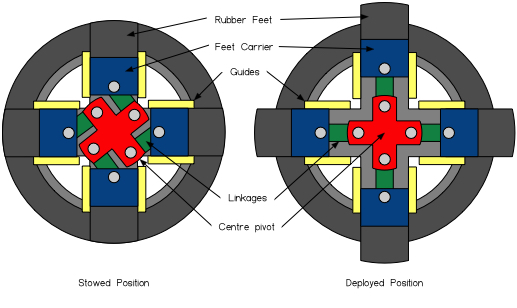
The number of feet in this instance is four however any number of feet to a point could be placed on a wheel using this mechanism. In configurations with more feet, a locking mechanism to hold the feet in the desired position may not even be needed. In this case in the deployed position the user could over-rotate (compared to the figure) to a stop and the weight of the pram on the lowest foot would hold the mechanism on the stop and in the correct position. When stowed, the weight of the pram would prevent the feet from deploying.
This would open a world of possibility for the desperate parent as even indoor surfaces and small spaces become suitable for putting the child to sleep. The night now free of parents being dragged about by a stroller could return to its rightful owner – the urban speleologist.
First, as is quickly becoming tradition, some choice lines…
Clearly this wasn’t written by a parent. No parent would have time to produce such a detailed engineering sketch.
Did the author consider noting ‘patent pending’ on this article the Shark Tank judges ask?
Finally, “Your Thinking Needs to be Squared” writes…
I don’t blame you, but rather your tertiary education as your solution is a clear-cut case of over-engineering. Why re-invent the wheel? (pun intended).
As with most things in life, the simplest solution is often the best. So I’m scratching my head as to why any parent would complicate his/her/their already hectic life with something with so many extra moving parts that it would no doubt fail.
My solution is a simple one: square wheels.
The Mythbusters already proved they work (please see link below), making it obvious that anything else is simply an exercise in engineering frivolity and wasteful design.
And before you argue how your design allows you to easily switch between round and bumpy, I can once again offer a simple solution. Buy two prams – one with square wheels and one with round wheels.
 A Week to Critique