Arkady Galt | A scalable solution to the housing and sustainability crisis
In the apartment above us, I hear incessant scratching which I hope is a dog but sometimes picture to be a massive rat crawling through the walls. To our side there are the sounds of late night urination that are so loud and prolonged I can only assume the neighbours are keeping a horse as an indoor pet and are training it for a long distance precision peeing.
These are some of the trivial trials of apartment living, but are they the real reason that most Australians retreat to a freestanding home protected by a moat of grass? Urban planning books actually say that living in densely packed cities is better for our quality of life, better for our health, better for the environment, better for the economy, and just generally better. So what is going on with us – why are we so apparently irrational (at least communally) when it comes to housing? There are 3 main issues that dent the cause for dense living: strata, space and supply.
Strata committees, with the unpredictable power they wield, undermine the sense of independence and security we crave regarding our shelter. A cohort of zealous residents could approve unnecessary works on your building and increase strata fees beyond what you budgeted for, or pass by-laws on just about anything. Committees controlled by a developer or absentee landlord could withhold important improvements and maintenance. Finally, strata tile robs home owners of the power to pursue their own dreams, tastes and projects on their “land” and consequently deprives the community of the diversity in streetscape and housing options that such freedoms yields. There is a clearly a fundamental problem with the strata title system as the way of governing dense living environments.
If the uncertainties of the strata committee were dealt with though, you still have to deal with the rat in the wall, the peeing horse and the tiny tiled balcony that struggles to grow even a weed – what you really need is space, or at least the sense of it. Space for privacy, space for a connection to nature, space to bring up a family and let the kids play on the grass. This desire for space is deeply engrained in the Australian psyche and it needs to be incorporated into denser housing arrangements if they are to replace the detached house as the desired home for families. In a classic chicken and egg problem, apartments are mostly thought of as a stepping stone for young people or a ghetto for the poor, so that is the type of design that developers build. There is also nothing pushing against the natural economic motivation to build as many apartments as possible, as cheaply as possible, on a given block of land. With this need for space remains unmet in our classic apartment housing market, suburbia on the distant urban fringe continues growing like mold on a Petri dish, out-competing the other uses for our most fertile land and accessible wilderness along Australia’s eastern seaboard.
Why has the market not yielded supply of innovative denser housing options if they are so good? Alongside the strata and space issues, regulations and approvals are a killer of innovation today. A developer can lodge a single development approval for a massive subdivision of 500 identical homes on the urban fringe, but would have to fight out the approval of each building individually if it were going to build those 500 dwellings in a number of apartment blocks within the existing city. Apartment buildings are also more complex to build and for councils to assess and it can be a lottery as to what comments and obstacles the local residents will throw up in its path. In the cut throat time critical world of real estate development, it is just much more profitable to build either suburbia on the fringe or dehumanising concrete box apartments designed for the lowest common denominator.
What we need is a new housing framework that:
- Gives people the same sense of independence and security as freehold land but allows for residences on top of others and hassle-free governance of the shared assets
- Yields denser housing designs that are also spacious and desirable for families
- Can be rapidly scaled to deliver lots of quality housing stock affordably and quickly
The Idea
If it is conceded that individual choices and markets are the best way to deliver results, then the ideal solution is to change rules governing the housing market and then interfere as little as possible on building design details. To change the market so that the above outcomes are better met, the idea of volumetric freehold combines a new type of “freehold land” ownership title with some simple and easily assessed rules for how those volumes are arranged in space on a site and how the shared structural parts (kept to an absolute minimum) are built and governed.
In additional to the normal lot boundaries of earth, fences, council building height limits and street-fronts, volumetric freehold lots could also be bounded by structural platforms below and above and one or more shared walls of prescribed quality (for excellent noise insulation) with nominated doorway locations. Specifications for attaching to the “structural framework” and utility connection points designed for easy access would also be part of the title. Just as with normal freehold title, owners would have the freedom to build whatever they want within the volume of space they own. In practicality, the initial developer of the block may “pre-fill” the lots with residences but these should be customised and assembled off-site then efficiently inserted into the framework in a non-destructive way to allow for future replacement or modification.
Shared assets like the structural platforms and walls, standardised lift and fire stair columns and minimal communal paths and gardens would be designed by regulation for long-term resilience and minimal maintenance. Management of these assets could be entirely handed over to council after initial construction in the same way as streets and parks in new subdivisions are, or perhaps transitioned to an ultra-minimalist and constrained type of strata management with externally prescribed “rates” and performance expectations.
The plan as described so far would deal with the strata and supply issues and dense but flexible housing quickly and affordably, but the spaciousness and “quality of life” issues would require some more regulations about how the volumetric lots are sized and located on a site. For example:
- For a given area of land, a certain number of lots of a certain variety of sizes must be allocated to achieve moderate density targets and cater for various households in the community (ie, young singles or couples, small families, large families, retirees or disabled, etc.)
- Access to sunlight for all lots and % of perimeter boundaries in each lot that are open to the air
- Privacy for all lots (such as by prescribing obstacles to lines of sight between lots)
- % of space within lots that must be open-air/green space
- % of lots that must have ground level gardens, or % of overall land in development that must be green
The important thing about these regulations is that they do not dictate any stylistic details of what people build in their lot and they are easily assessed, potentially via a website for instant approval.
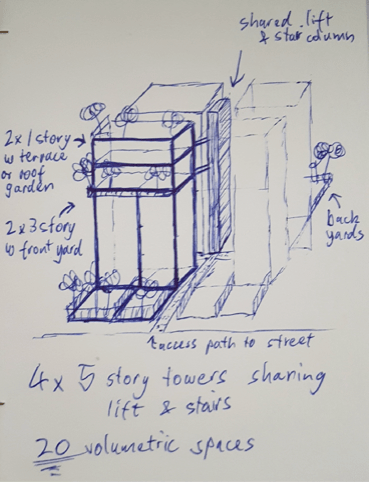
In summary, this new volumetric freehold option and the accompanying construction techniques, regulations and governance approaches would make dense and affordable housing for the average Australia much more desirable and faster to deploy at scale. I concede that it would still not be as desirable as a massive freehold block on the shores of Sydney Harbour, but this entire concept is in in the context of our current suburban sprawl approach being destructive to ourselves and the environment and hence not a valid (or ethical) option going forward. This proposal unlocks the potential of emerging technologies like automated home construction and transport as a service to usher in a new chapter of Australian urban life that captures the benefits of density withouts its drawbacks.
First, some choice morsels from other responses…
An attractive proposal from a philosophical and technical point of view. The idea of customisable ‘cassettes’ that readily slip into positions within a supporting structure is superbly simple. A vision of construction drones lifting one’s entire home into position in the ten minutes before you move in is an exciting one.
The question of space would not necessarily be resolved… The economic incentives towards smaller and smaller allotments would still exist in the longer term. For councils to maximise rates and the developers or even title holders to maximise return would not be removed inherently in this scheme. As usual strong governance measures (which is to say good law and good enforcement) are not substituted by any particular philosophical underpinning.
…I don’t believe high density living is better. I would much rather live in a tent where I could fire a potato from a rudimentary spud gun in any direction without it leaving the property than a suburban 1/4 acre leave alone even a finely appointed apartment. I think the freedom longed for (or perhaps a conflict-less existence) is impossible to achieve in any context or under any governance structure where you are in near-constant contact with your neighbours.
Your vision for modular, semi-communal 21st-Century HDB (see: Singapore) is admirable, but it doesn’t solve for the main issue: neighbours would still be [expletive deleted]
Finally Anonymous writes…
Arkady makes a commendable effort to attempt to resolve a large-scale societal issue, with some practical issues that may limit take-up and therefore effectiveness of the proposal.
Urban sprawl and overpopulation is a major issue, causing (among other things) environmental, economic, and societal issues. The primary issue is that geographic space is of course limited. This drives up land prices, as demand overcomes supply, and pushes urban sprawl outwards, causing environmental issues. Creative town planning solutions are therefore needed to overcome this issue.
In my view, Arkady’s proposal has a lot of merit. It would, in principle, allow people a greater degree of freedom and therefore provide a greater incentive to purchase units for long-term living or investment. However, there are some practical, economic, legal, aesthetic and societal issues that would need to be overcome.
Practically, I question the engineerability of the proposed lots. As I understand it, Arkady is proposing large, multi-level towers designed like divided bookshelves, such that each lot does not have internal partitions (to allow customisation). Many internal walls are structural and engineering away all internal partitions may not be feasible (but I will leave that to the engineers).
Economically, this may drive down supply by de-incentivising developers from constructing apartment blocks. This is because developers currently (generally) secure favourable finance conditions for these developments by pre-selling units off the plan. They do so by attracting buyers with high-end fit outs and other incentives (such as free appliances). If they were instead required to build a standardised tower with basic fit-outs, it would likely reduce the ability of developers to incentivise buyers off the plan.
Legally, you would be asking a lot of the Council. Recently, we have seen a lot of defect issues with multi-level residential towers (e.g. Opal Tower in Sydney). This is caused by developers constructing these developments using the cheapest builder (which then naturally uses the cheapest work methods and materials). Where these issues come to light (as they inevitably do in these developments), there is often a bunfight between the developer, builder, architect, certifier, subcontractors and various consultants as to whose responsibility the defect is. Passing all ownership of structural elements to the Council would require the Council to (likely) manage a high volume of litigation.
Aesthetically, I believe that allowing entirely bespoke spaces within the same apartment block may result in a cacophony of customisation; a hodgepodge of habitats akin to the ‘stacks’ in the Spielberg film, Ready Player One. Personally, I am not sure how I would feel if I decorated my apartment in tasteful muted pastels, only to discover my neighbour preferred a bright pink colour scheme. There is a reason that strata schemes currently require approval to carry out changes affecting the outside look of an apartment block.
Societally, recent events may lessen the demand for unit living. There have been countless articles written recently about how a post-COVID world might look, but one thing that seems for sure is that the attractiveness of living in densely packed areas will be diminished. There’s nothing like being trapped in an apartment for months on end to make you realise their limitations. Further, the obvious increase in remote working reduces the need for densely packed urban spaces close to the CBD.
Ultimately, I believe that Arkady’s proposal is a step in the right direction. As a species, we cannot continue expanding our population without finding ways to live more closely and with less of an impact (unless of course we move off-world, which seems a while away). Otherwise, we will only accelerate the decline of the natural world and towards a (seemingly inevitable) future of climate change catastrophe and resource scarcity.
 A Week to Critique